Get in your inbox the latest News and Offers from
- 304, Fortune Business Centre, Kaspate Waste Road, Wakad, Pune - 412101.

- Office Time:
- Monday - Friday 9:00 AM to 9:00 PM (IST)
- Call Us:
- +91 9699 611265
- Email:
- info@saacriti.com
Unlock Global Growth: Why India is the Prime Location for Your Digital Marketing GCC
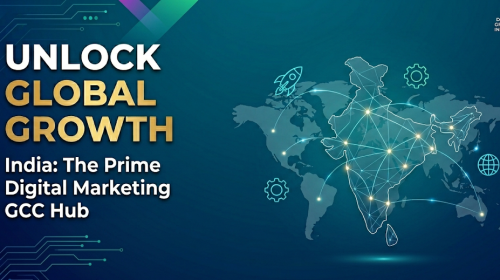
Unlock Global Growth: Why India is the Prime Location for Your Digital Marketing GCC
The global marketing landscape is undergoing a quiet, yet profound, migration. Over the past few years, the mandate for Chief Marketing Officers has shifted dramatically from traditional brand-building to managing complex, data-driven revenue engines. In 2026, capturing audience attention requires continuous signal analysis, hyper-personalized content supply chains, and agile execution. To support this relentless pace, global brands are no longer just looking for external agencies; they are building internal powerhouses.
Enter the Digital Marketing Global Capability Center (GCC).
India has firmly established itself as the epicenter of this movement. The narrative that India is simply a destination for cost arbitrage is obsolete. Today, the Indian GCC ecosystem is a $98 billion juggernaut, having evolved from operational back-offices into the central, strategic nerve centers of global enterprises. For organizations looking to scale their digital marketing strategies, here is why India is the ultimate launchpad.
1. The Convergence of MarTech, SaaS, and Digital Strategy
Modern digital marketing is deeply intertwined with complex technology stacks. Executing a global strategy requires more than just creative copywriters; it demands technical architects who understand the entire customer journey.
India's talent pool offers a unique and highly sought-after intersection of marketing acumen and deep technical expertise. Whether it is managing enterprise e-commerce accounts, administering complex SaaS products, or leveraging platforms like Salesforce to drive seamless sales enablement, the workforce in India is uniquely equipped to handle the heavy lifting. This ability to seamlessly integrate CRM data with multi-channel digital campaigns is what turns a standard marketing operation into a high-converting global engine.
2. The Shift from Execution to Enterprise Intelligence
Historically, offshore marketing centers handled repetitive tasks like basic social media posting or rudimentary email deployment. In 2026, the mandate is entirely different.
Global brands - from retail giants like McDonald's to consumer goods leaders like Heineken - are building intelligence hubs in India. These centers are taking full ownership of critical, high-value functions:
Advanced Customer Analytics: Building predictive models to understand purchasing behavior and reduce churn.
Retail Media Networks: Managing and optimizing complex retail media ad spend.
AI-Model Operations: Deploying generative AI to scale personalized content creation securely and effectively.
When you set up a GCC in India, you are not hiring a team to follow a playbook; you are building a team to write the playbook.
3. Unmatched Scale and Speed to Market
The competition for digital attention is fierce, and agility is a competitive advantage. India offers an ecosystem built for rapid scaling. With a massive pipeline of STEM graduates and seasoned professionals with a decade or more of experience in global digital operations, companies can assemble specialized pods - comprising data scientists, media buyers, UX strategists, and marketing automation experts - at a speed that is nearly impossible to replicate in Western markets.
Furthermore, the maturity of the Indian market means you aren't starting from scratch. Proven governance frameworks, experienced GCC leadership, and a deep understanding of global compliance and data security (like GDPR and CCPA) are already embedded in the local corporate culture.
4. Continuous Innovation and the "Smart Cost" Advantage
While cost reduction is no longer the sole driver, the economic efficiency of an Indian GCC cannot be ignored. However, the modern approach is a "smart cost" model. The operational savings achieved by centralizing global digital marketing efforts in cities like Bengaluru, Hyderabad, or emerging tech hubs like Pune, are reinvested directly into innovation.
By automating repetitive tasks and streamlining vendor relationships, your GCC can direct its resources toward higher-value initiatives?testing new digital channels, developing proprietary marketing algorithms, or building robust, data-driven sales enablement pipelines.
The Strategic Imperative
Establishing a Digital Marketing Global Capability Center in India is no longer an experimental move; it is a strategic necessity for global growth. The brands that are winning today are the ones that recognize India not just as a place to execute a strategy, but as the ideal ecosystem to engineer their entire digital future. By tapping into a workforce that masters the nuances of digital marketing, complex SaaS integrations, and advanced data analytics, organizations can build a resilient, scalable, and highly profitable global marketing engine
How Saacriti Solutions can help
At Saacriti Solutions, we bridge the gap between global digital strategy and local execution excellence. Leveraging 15 years of deep-rooted experience across digital marketing, SaaS administration, and e-commerce account management, we provide a turnkey solution for organizations looking to establish a high-performing Global Capability Center (GCC) in India.
Here is how we help you scale:
Strategic Hub Design: We design your GCC roadmap, transitioning your operations from simple cost centers to strategic intelligence hubs that drive global revenue.
MarTech & Salesforce Mastery: We specialize in aligning complex technology stacks, including Salesforce and enterprise SaaS products, to ensure your India-based team delivers seamless sales enablement and automated marketing journeys.
Operational Excellence: From navigating the local talent landscape to implementing robust governance frameworks, we ensure your center is built on a foundation of agility and data security.
E-commerce & Digital Growth: Our expertise in managing large-scale e-commerce accounts allows us to help you build teams that don't just execute tasks, but optimize your entire digital storefront for a global audience.
Saacriti Solutions doesn't just help you set up an office; we help you engineer a digital powerhouse that acts as the heartbeat of your global marketing strategy.
How large of a team are you looking to start with for this GCC - are you thinking of a small pilot team or a full-scale operational hub?
Let's Talk
www.saacriti.com | +91 7767911265 | info@saacriti.com